OSS4AI AI Stack · Season1 · #6
by Yujian Tang
An illustrated introduction to AI agent engineer roadmap. Treat the headline as a topic introduction, not a universal performance or capability claim. Open full-size image
Learn the dependencies, not just a framework
An agent can be understood as a model in a loop that chooses actions, calls tools, observes results and continues until a stopping condition is met. Building one involves more than choosing a framework. You need to know what the model consumes, how it runs, where its evidence comes from and what happens when a tool fails.
A useful learning route begins with models, then inference, retrieval and agents. This is a recommended dependency order, not a mandatory career ladder. You can build small projects while learning, and revisit earlier topics when a later failure exposes a gap.
First, make the model concrete
Learn tokens, embeddings, attention and transformers. Distinguish downloadable weights from open-source training artifacts, and read the license before deciding what you can distribute.
The practical exercise is to run a small open model on hardware you can access. The important result is being able to explain the path from text to token IDs to generated output. Do not start with a model too large for your machine just because its name appears in a benchmark.
Keep a record of the model, tokenizer and generation settings. That record makes later experiments easier to compare.
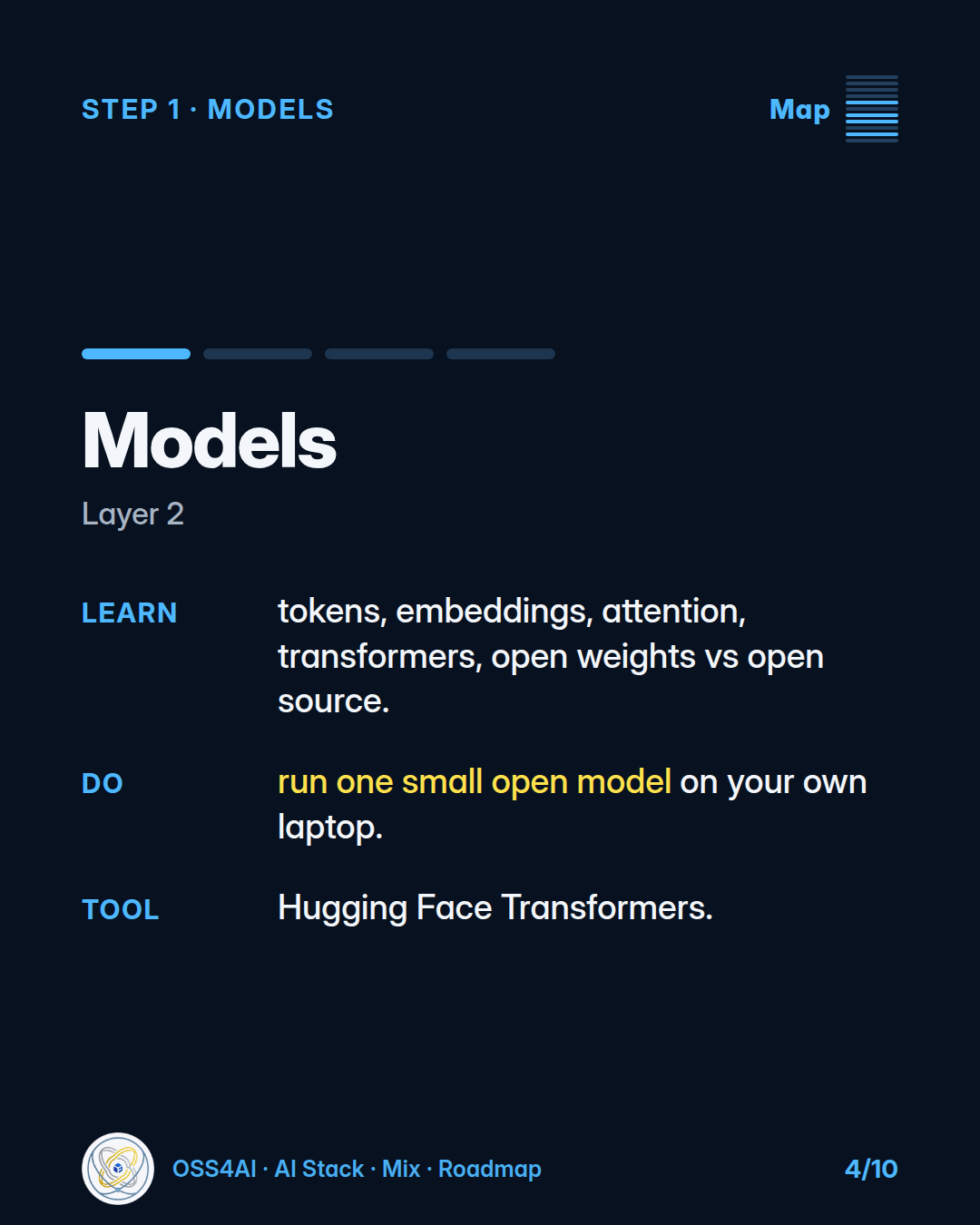
Run a small model and learn tokens, embeddings, attention and architecture. Open full-size image
Then measure inference
Inference is the computation that produces an answer from trained weights. Learn time to first token, output tokens per second, the key-value cache and quantization. These concepts connect the model's architecture to the behavior your users experience.
Ollama is a practical local starting point; vLLM introduces a serving-oriented environment. Treat this as a progression of questions, not an instruction to replace one tool with another immediately. Serve a model behind an API, send repeatable requests and measure it.
Separate waiting for the first output from the speed of subsequent generation. A system can feel slow even when its advertised generation rate looks impressive.
Add evidence before autonomy
Retrieval-augmented generation, or RAG, supplies relevant source material at question time. Learn document parsing, chunking, vector and keyword search, and re-ranking. Choose parsing and search tools that preserve the source text and its origin.
Build a question-answering system over a small document collection. Make it return citations and inspect whether those citations actually support the answer. Include a question the documents cannot answer. A plausible response is not evidence that retrieval succeeded.
This project teaches an important boundary: the model's fluent writing and your system's access to reliable information are separate capabilities.
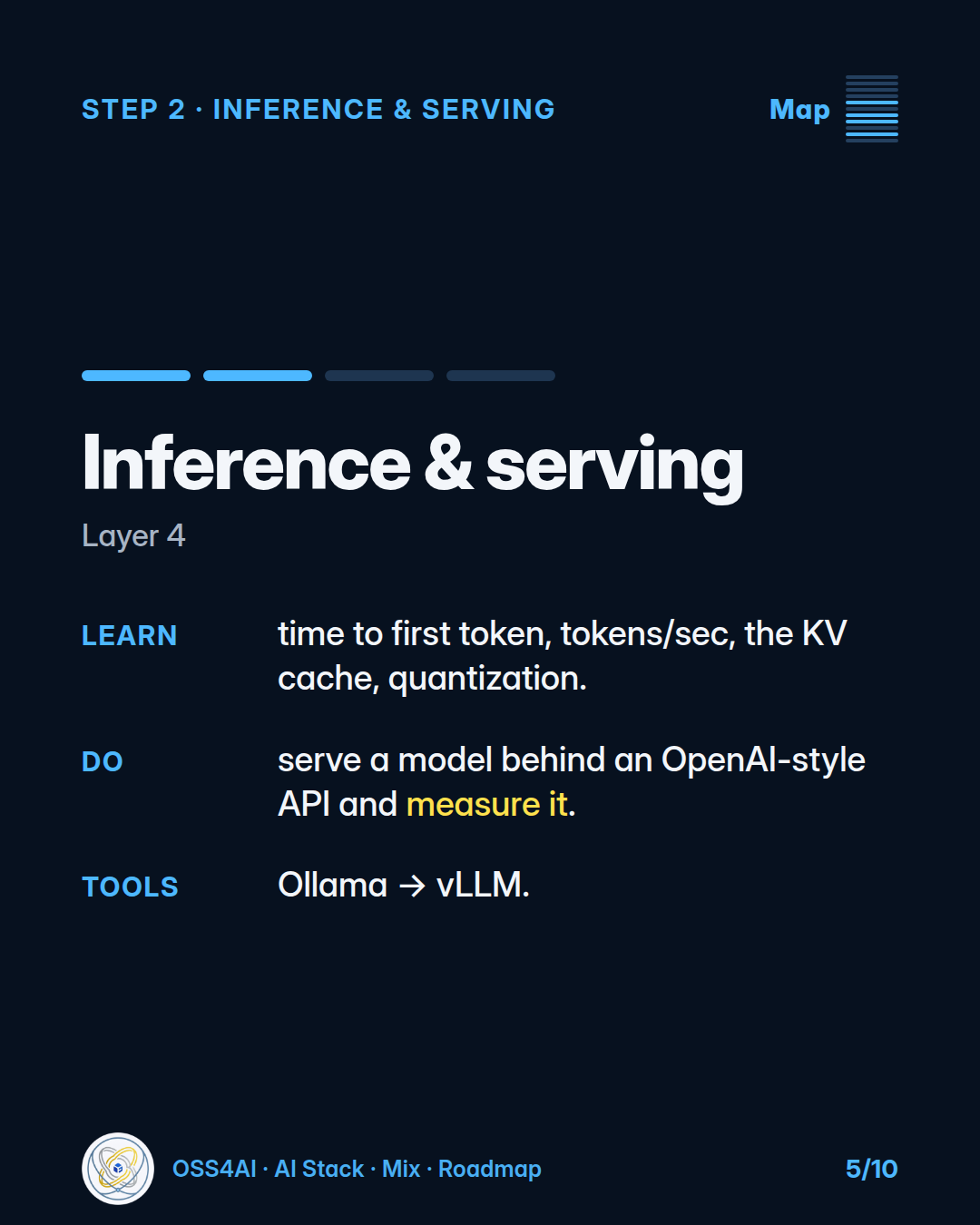
Measure time to first token and generation speed, and study cache and quantization. Open full-size image
Introduce a bounded agent loop
Next, give a system two tools and a clear objective. Learn tool schemas, error handling, memory, MCP and human review. MCP standardizes integration with tools and data; it does not decide whether a requested action should be allowed. A workflow needs explicit state and stopping rules, regardless of the library used.
Choose a reversible exercise, such as reading a document and calculating a summary statistic. Define success, a maximum number of steps and what to do after a tool error. Require human confirmation before consequential actions. A loop that stops correctly is a more useful first milestone than one that can call many tools.
Shipping requires another set of questions
The wider roadmap includes frameworks, evaluations, observability, guardrails, application design, fine-tuning and compute. These are optional areas to investigate according to the application's failures, not mandatory tools for every agent. Evaluation can begin with saved inputs and an explicit checklist; tracing can begin with a record of requests, selected tools, arguments and results. More infrastructure should answer a concrete reliability or deployment question.
These topics are not postponed until the end. Basic tests and traces belong in the first working prototype. Guardrails should be treated as defense in depth, not a guarantee against prompt injection. Fine-tuning is an option when evaluation shows a gap that prompts or retrieval do not resolve, not a default upgrade.
The roadmap is successful when you can demonstrate a small, measured, evidence-grounded and bounded application. Tool names will change. The questions about inputs, reliability, permissions and failure remain useful.
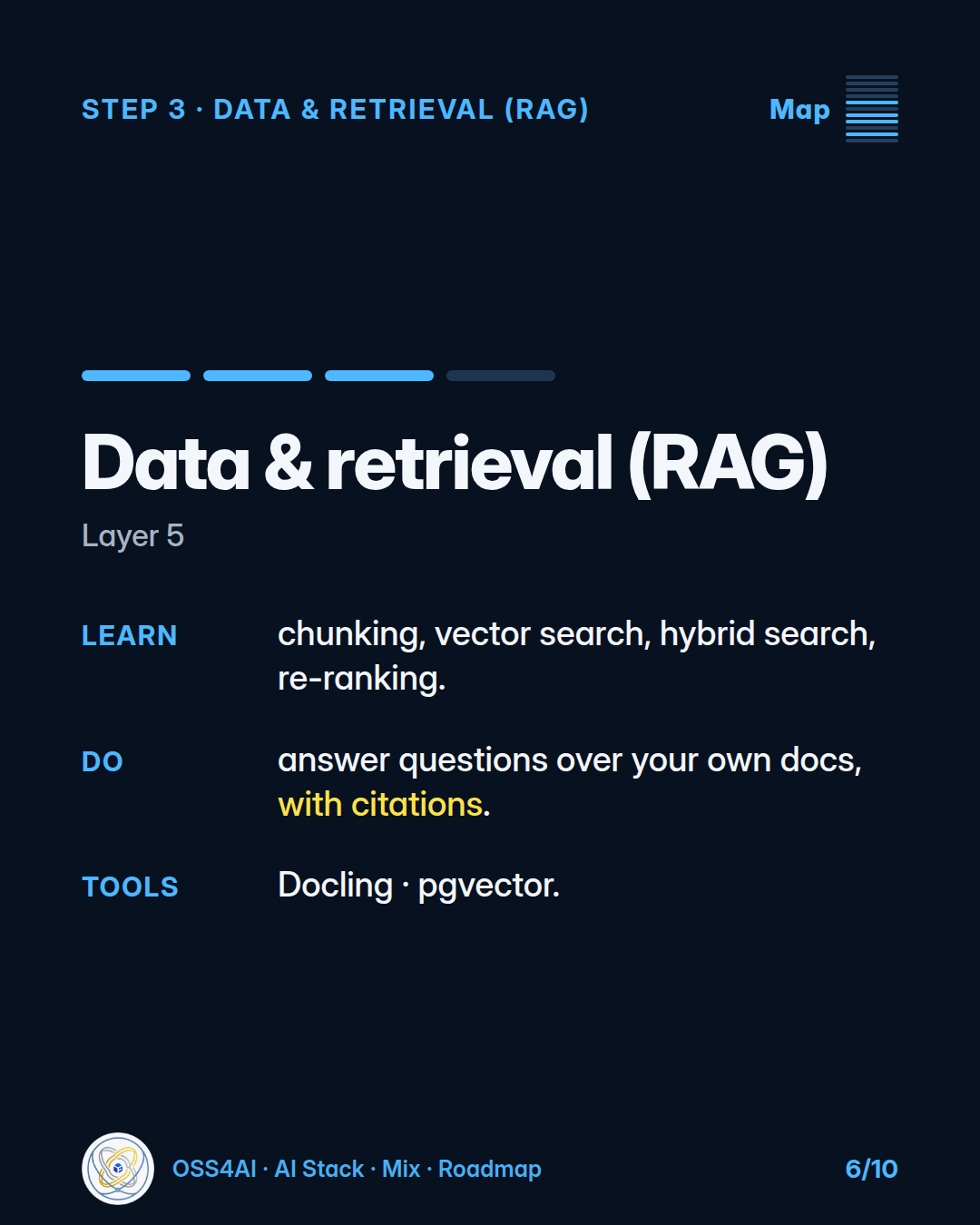
Learn document processing, retrieval and re-ranking; verify that cited passages support an answer. Open full-size image

