OSS4AI AI Stack · Season1 · #4
by Yujian Tang
An illustrated introduction to "Open model" means 3 things. Three practical questions about model openness; these are not formal legal categories. Open full-size image
Downloadable is not the same as open source
A model combines learned numbers, called weights, with an architecture that uses those numbers to transform inputs into outputs. You can access some models only through a hosted API. Other models let you download the weights and run inference yourself.
That second option is often described as an "open model." But downloading a file does not tell you whether you can redistribute it, build a commercial service around it, or reproduce its training. Those are separate questions. Treat openness as a checklist rather than a badge.
The distinction matters before you choose a model, not just when you ship. A technically suitable model can still have terms that conflict with the way you want to distribute your application.
Three useful meanings
Open weights means the weights are available under the maker's terms. It gives you access to the trained model, but the license may add requirements beyond ordinary permissive software licenses. Llama 4's community license is an example.
Open weights under a permissive license means the released weights use terms such as MIT or Apache-2.0. Examples include the original DeepSeek-R1 weights under MIT and gpt-oss under Apache-2.0. R1 distills derived from other base models can retain those base-license obligations. These licenses allow broad use, modification and redistribution, subject to their conditions. They do not mean there are no obligations.
Training transparency goes further: weights, training code and information about the training data are available. The historical OLMo release is an example for studying how a model was made, not merely how to run the finished artifact. Its legacy repository is now inactive; OLMo-core provides a separate training-code reference. Inspect the named release's artifacts rather than assuming one repository proves completeness.
These are practical categories, not a substitute for a formal definition. A project may release different artifacts under different terms, so check the weights and code separately.
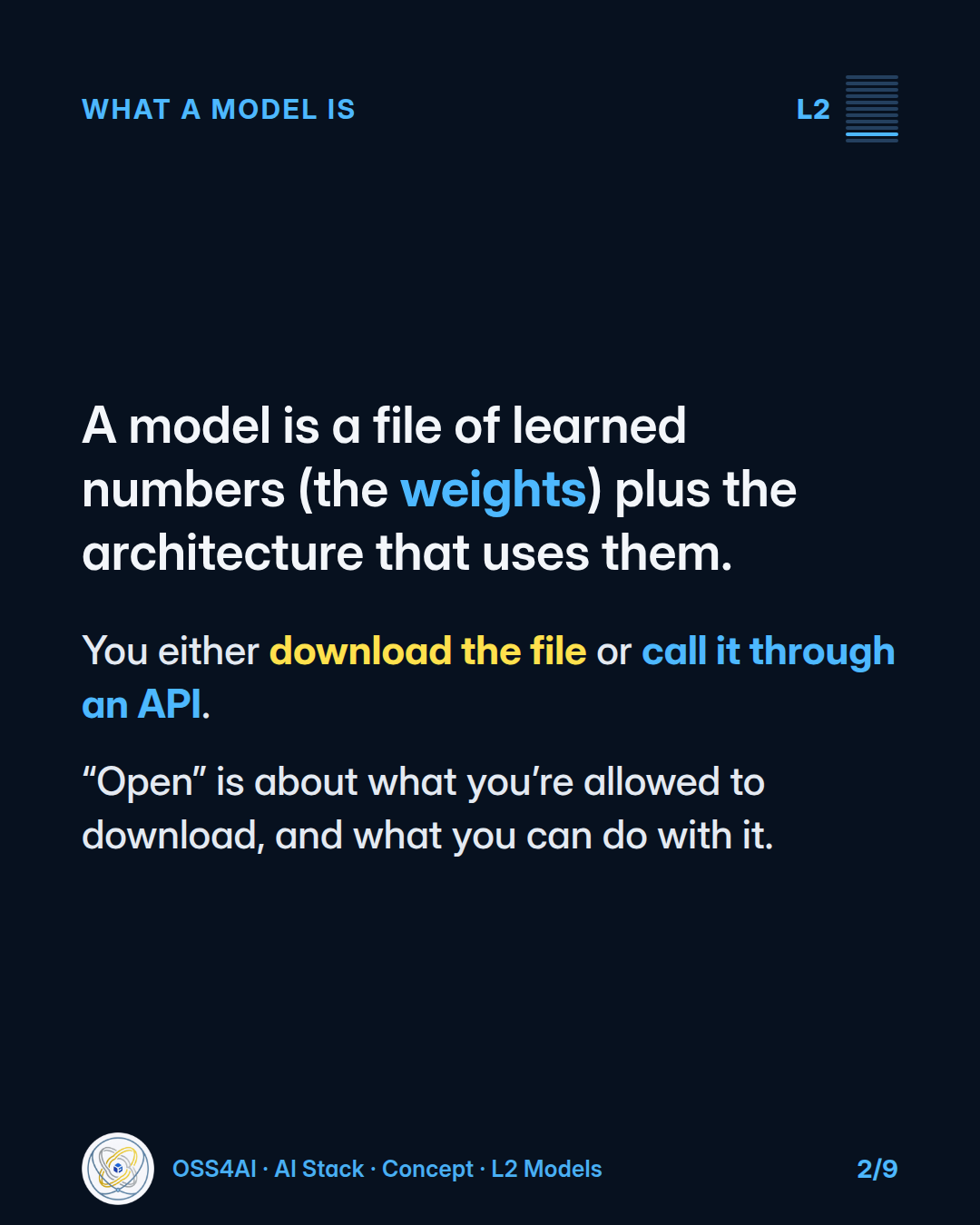
A model combines learned weights with an architecture; some artifacts are downloadable and others are accessed through an API. Open full-size image
What the formal definition asks for
The Open Source Initiative's Open Source AI Definition 1.0 identifies data information, code and parameters as essential components for modifying an AI system. Data information should be detailed enough for a skilled person to build a substantially equivalent system. Code covers training and operation; parameters include the learned weights.
That is more precise than saying "all training data must be downloadable." The definition calls for data information, which is not identical to releasing every raw training record. Conversely, releasing weights alone does not meet this transparency bar.
If your purpose is research or auditing, ask whether you can examine the training recipe and data composition. If your purpose is deployment, ask whether the released model fits both your infrastructure and your legal use case.
Read the terms against your deployment
The cited Llama 4 license illustrates why the details matter. It includes a separate-license condition if, as of the Llama 4 release date, the licensee or its affiliates' products or services exceeded 700 million monthly active users in the preceding calendar month, a "Built with Llama" notice, and naming requirements for certain distributed models trained using Llama materials or outputs. The exact scope belongs in the license text, not in a launch headline.
A practical review starts with four questions: Which artifact are you downloading? Which license covers it? Are you distributing weights or only serving outputs? Do attribution, naming or scale conditions apply to your intended use?
For a product, permissive terms can simplify this review. For a reproducibility project, permissive weights without training information may still be insufficient. For a prototype, downloadable weights may meet your immediate needs, but do not assume prototype terms automatically cover a later release.
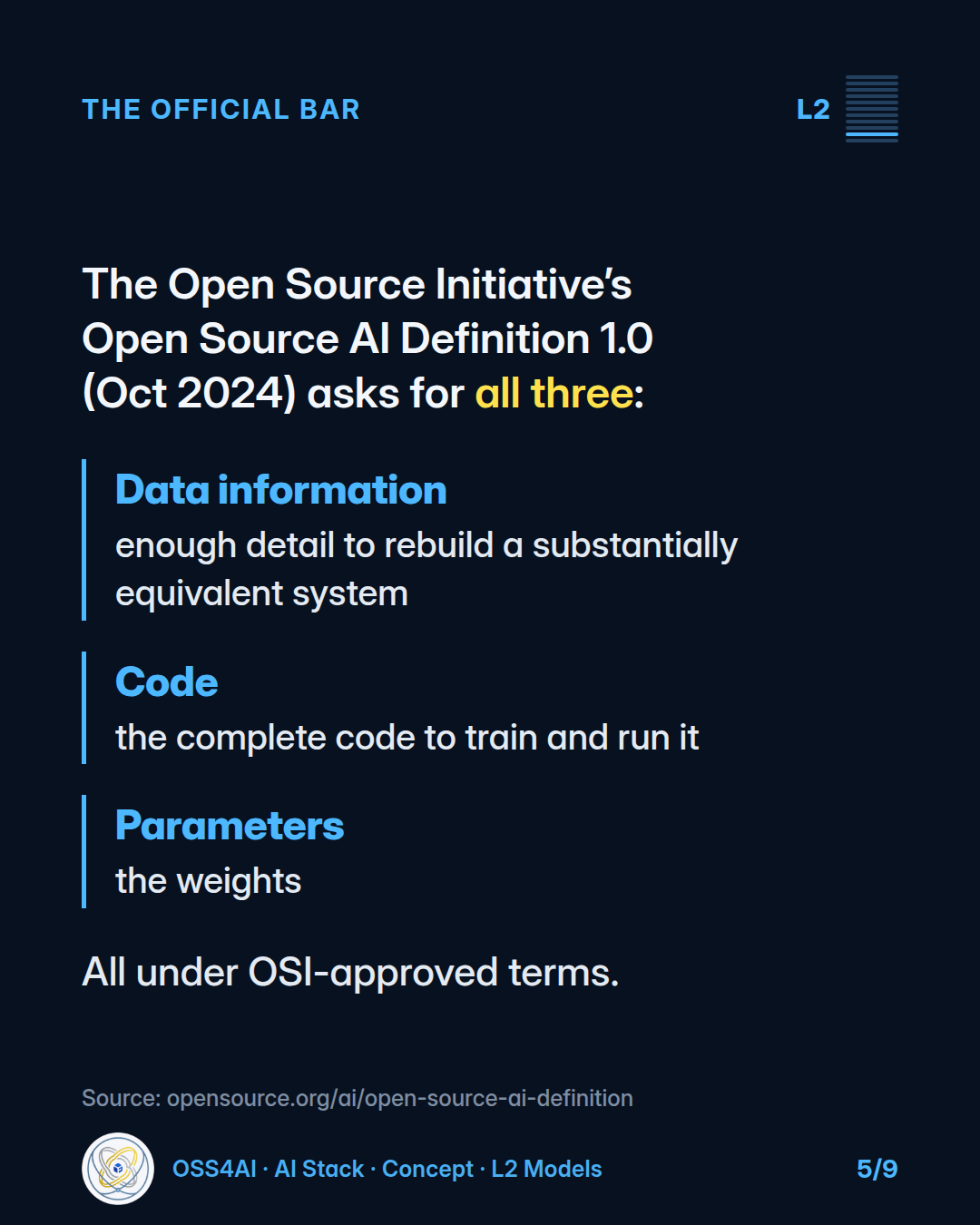
The OSI definition calls for data information, code and parameters—not necessarily every raw training record. Open full-size image
Openness does not guarantee suitability
A permissive license is not a quality benchmark, a privacy guarantee or a promise that training can be reproduced cheaply. You still need to evaluate output quality, hardware requirements and data handling. Fully documented training can be valuable without making a model the best choice for a particular application.
Use the three-way distinction to identify what you need, then read the actual files. This is engineering guidance, not legal advice. For consequential distribution decisions, a short summary should not replace qualified review of the applicable license.

