OSS4AI AI Stack · Season 1 · #3
by Yujian Tang
Original Season 1 MCP comparison cover. Open full-size image
The model proposes; code executes
A model returning a tool call is not the same as the model executing a function. That distinction holds with or without the Model Context Protocol, or MCP.
In a typical tool-calling workflow, the model returns a tool name and arguments. Application code decides how to handle that request, executes the operation, and supplies the result back to the model.
The distinction is between producing a tool-call request and running the tool. The output may be structured, but it is still the surrounding software that makes the request to another system.
MCP changes the integration around that boundary. It does not move execution into the model.
Plain tool calling is already useful
Imagine an application with a get_weather tool. Without MCP, the workflow can be straightforward:
Your application sends the model a JSON schema describing the tool and its arguments.
The model returns the name
get_weatherand arguments for the requested location.Your application code calls the weather API.
Your application sends the result back into the conversation.
For one application and a few tools you own, this can be the simplest approach. There is no requirement to add a protocol layer merely because a model is involved.
The trade-off appears when multiple applications need the same integrations. Each application may need its own glue code for presenting and calling those tools. MCP offers a standard interface for that part of the work.
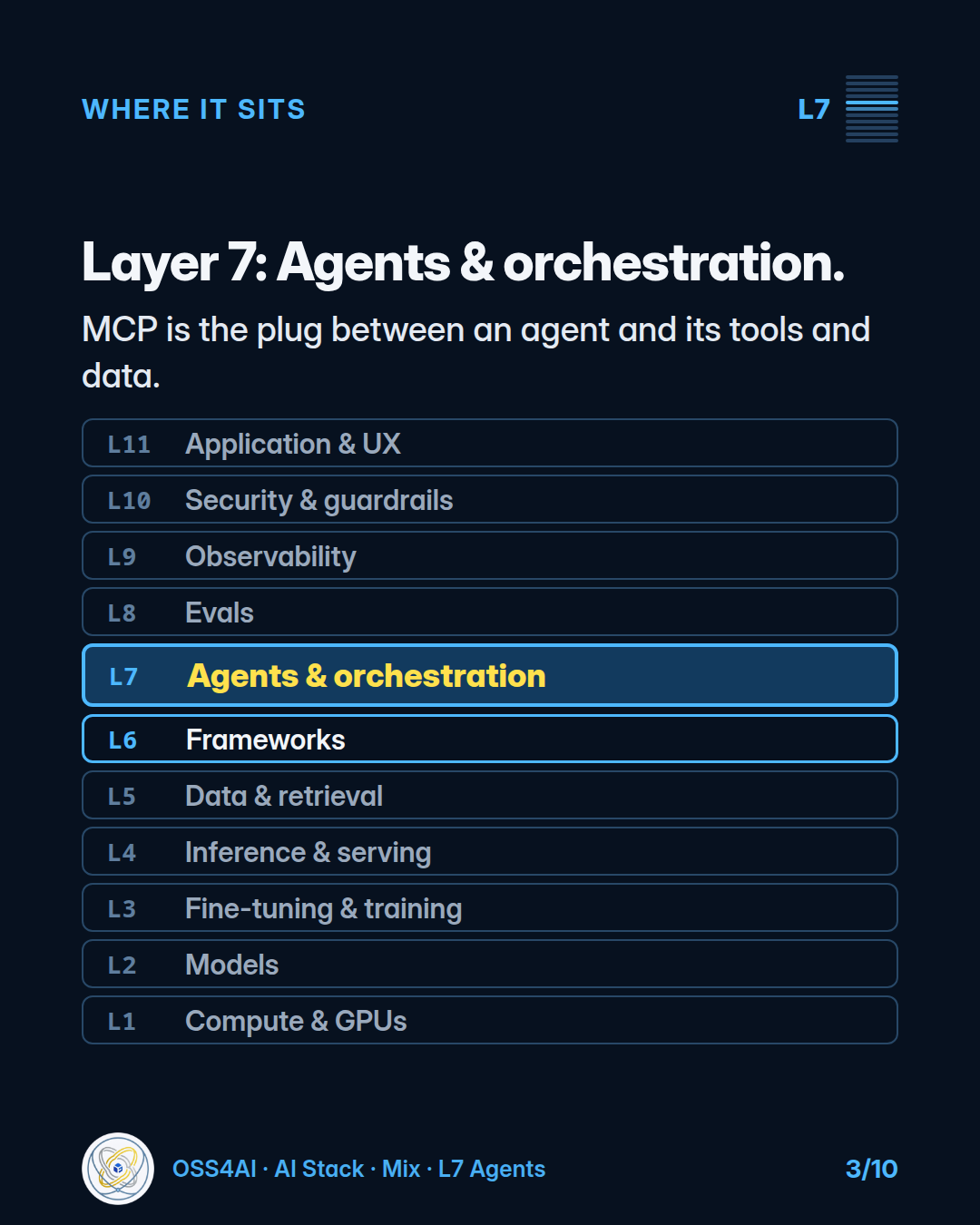
MCP connects an AI application to tools and data in the orchestration layer. Open full-size image
Host, client, and server
MCP is an open protocol using JSON-RPC 2.0 between an AI application and servers that expose capabilities. Its architecture separates three roles:
Host: the AI application, such as VS Code, Claude Desktop, or Cursor.
Client: a component inside the host that maintains a connection to a server.
Server: the component exposing tools, resources, and prompts.
The architecture supports stdio for local connections and Streamable HTTP for remote connections.
For tools, the client can discover what a server provides with tools/list, then request execution with tools/call. Discovery and execution are distinct operations: the model's request does not itself establish the connection or perform discovery.
The API often remains underneath
An MCP server commonly wraps the same API that application code would otherwise call directly. The difference is the standardized interface presented to AI applications, not necessarily the underlying operation.
For example, an issue-search tool may still use a service's API to retrieve issues. MCP describes how the host discovers that tool and requests it through the server.
“MCP is a plug, not a brain” is a useful shorthand, provided it stays a metaphor. The protocol is not an agent's reasoning process. It does not select a goal, guarantee a good tool choice, or make the underlying service disappear.
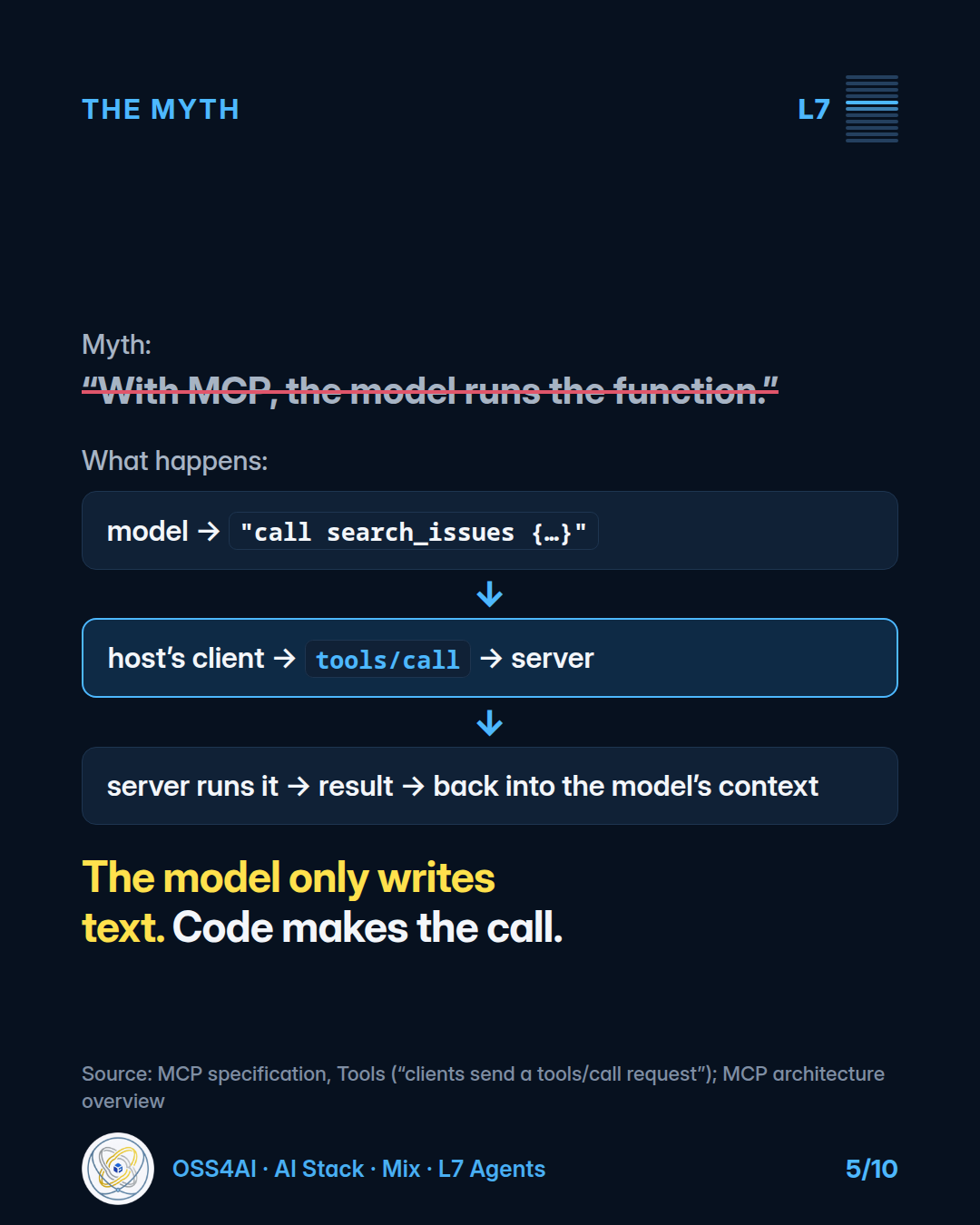
Tool-call requests may be structured, not just plain text. The surrounding application and server execute the operation. Open full-size image
When does the extra layer help?
A useful starting point is:
Use plain tool calling when one application needs a few tools you control. There are fewer components to connect and maintain.
Consider MCP when several applications should reuse the same tool interface, or when you want to connect tools that others have already packaged as MCP servers.
These are engineering recommendations, not findings from a benchmark. Reuse is a reason to consider MCP, not proof that it eliminates every application-specific integration task.
Examples include GitHub's MCP Server for issues, pull requests, and repositories, and Microsoft's Playwright MCP for browser interaction through accessibility snapshots. The latter describes its approach as bypassing the need for screenshots; that is an architectural emphasis, not a claim that screenshots can never be involved. Treat reference-server examples as learning material, not production-readiness guarantees.
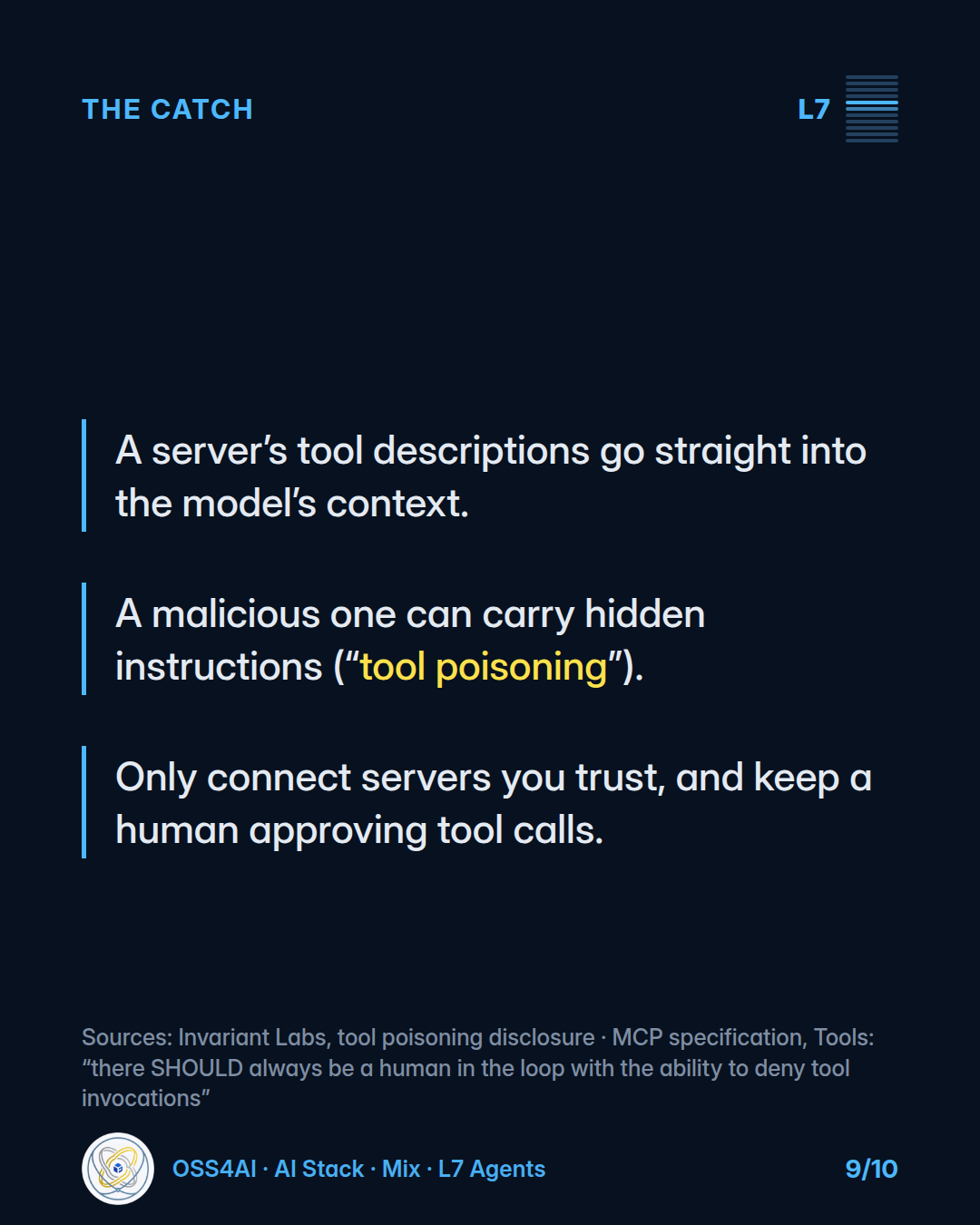
Tool descriptions can contain untrusted instructions. The protocol does not replace authorization, review and least-privilege controls. Open full-size image
Tool descriptions are also a security boundary
A server's tool descriptions can enter the model's context. A malicious description can carry instructions intended to influence the model—an attack described as tool poisoning.
Connect only servers you trust, and keep a human able to review and deny tool calls. Trust and approval do not make every operation safe, but the protocol is not a substitute for those controls.
The bottom line: MCP standardizes a connection to tools and data; it does not replace APIs or let the model execute functions by itself.
Sources and scope
Adapted from OSS4AI AI Stack Season 1 #3. No new server testing or security audit was performed for this adaptation.

